
Work the property in a fixed turnover order
Cleaning the same way every visit removes guesswork and missed rooms. Start with a quick damage and lost-property sweep, strip all linen, then clean top-down and back-to-front: bedrooms, bathrooms, kitchen, living areas, then floors last so you never walk dust back across a finished room. In a same-day Western Sydney turnover the linen cycle is the real bottleneck, so getting beds stripped in the first five minutes keeps the laundry clock running while you clean.
Kitchen and bathroom are the review-makers
Guests forgive a lot, but a greasy cooktop or a hair-in-the-drain bathroom kills ratings. Reset the kitchen completely: empty and wipe the fridge, descale the kettle, run or empty the dishwasher, sanitise benchtops and the sink, and restock tea, coffee and dishwashing consumables. In bathrooms, descale glass and taps, sanitise the toilet and basin, replace towels, and restock soap and toilet paper to a level that signals the next guest was expected, not squeezed in.
Restock, stage, and prove it with photos
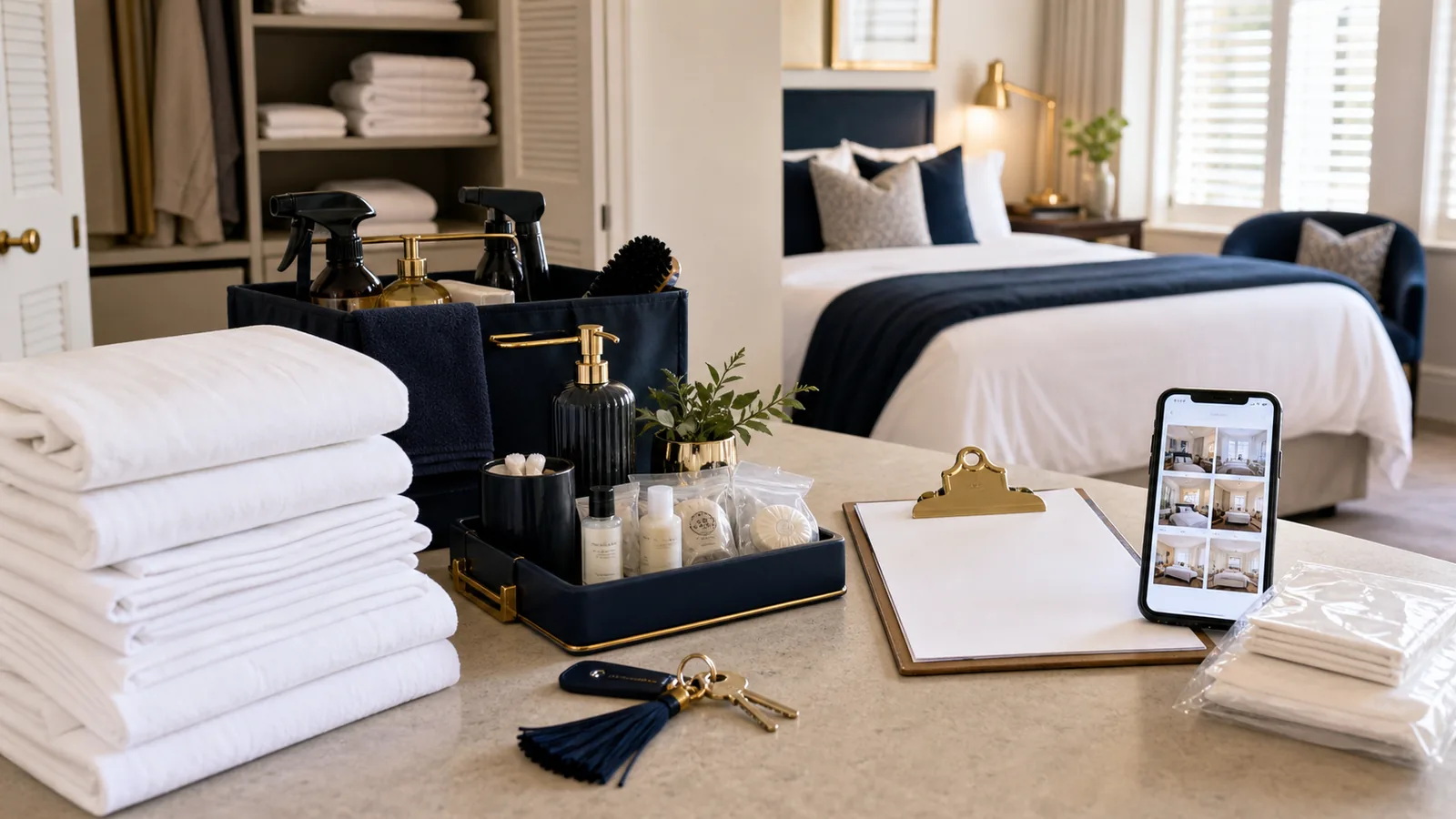
A turnover is also a merchandising job. Make beds hotel-style with fresh linen, fan the towels, reset the welcome items, empty every bin, and stage the living space to match your listing photos. Finish with a short photo set of each room — beds, bathroom, kitchen, and the welcome setup — so you and your cleaner have a timestamped record of the property's condition at handoff. This protects you in damage disputes and keeps standards consistent across cleaners.
Build a restock par-list per property
Every property runs out of something at the worst time. Keep a par-list of consumables — toilet paper, paper towel, dishwashing liquid, tea, coffee, sugar, bin liners, and spare linen sets — and check it on every turnover so the next guest never lands in an under-stocked listing. For hosts running multiple Western Sydney listings, a shared par-list lets any cleaner restock correctly without messaging you mid-clean.
Inspect the stay through a guest's first five minutes
After the cleaning route, return to the entry and act like the arriving guest. Check the key process, bathroom finish, Wi-Fi or remote location, drinking supplies, fridge, bed presentation and bin. This second route catches small trust-breaking misses that are easy to overlook when each room is considered in isolation.
Separate cleaning issues from maintenance issues
A cleaner should flag a leaking tap, failed globe, damaged linen or missing remote without being expected to repair it. A short handover note keeps the property safe and gives the host time to act before the next arrival instead of discovering maintenance through a guest message.
Where the factual detail comes from.
Details worth confirming.
How long does an Airbnb turnover clean take?
A one or two bedroom short-stay turnover usually takes one to two hours for a single cleaner, plus the linen laundry cycle. Larger homes, heavy check-outs or full linen handling extend that, which is why same-day turnovers are quoted on property size and the check-out to check-in gap.
Can a cleaner do a same-day turnover between guests?
Yes, when the schedule and check-out time allow it. The tighter the window, the more it helps to have linen supplied on-site or pre-laundered so the clean is not waiting on a wash cycle. Clean Up Bros captures the check-out and check-in times so the turnover can be confirmed quickly.
Should linen be supplied by the host or the cleaner?
Either works, but it changes the scope. Host-supplied on-site linen makes same-day turnovers fastest. If linen needs pickup, laundering and return, that is handled as an add-on and should be priced and scheduled into the turnover window rather than assumed.
How do photos protect a host?
A timestamped photo set at handoff records the property's condition immediately after cleaning. If a guest reports damage or a mess, the host has evidence of the state the property was left in, which supports any Airbnb damage claim and keeps cleaning standards measurable.